Google Business Profile for Coworking & Virtual Offices: What Actually Works in 2026
Getting on the map is still one of the cheapest ways to grow. But the rules for shared addresses got stricter, Google verifies harder, and it suspends faster. Here is how to do it for real.

Getting found on Google Maps is still one of the cheapest ways to grow a small business, and a Google Business Profile is where most of that starts. It puts you on the map, in local search, and now in front of AI answer engines too.
But the rules around coworking spaces and virtual offices have tightened since 2024. Google verifies harder. It suspends faster. And it is much better at spotting addresses that look fake. At Peachtree Rose Marketing, we help San Antonio businesses set these listings up the right way: people first, platforms second. Below is what still works, what changed, and how to protect your listing from a suspension.
A virtual office (a mailing address you do not work from) cannot have a Google Business Profile. A coworking space can, but only if you have permanent signage, your own staff on site during your posted hours, and customers who can visit. The policy has not softened since 2021 — what changed is enforcement. Expect video verification, extra scrutiny on shared addresses, and faster suspensions. The fix is simple: qualify for real, and keep your proof ready.
Why a Google Business Profile is still worth the effort
A Google Business Profile (GBP) is free, which makes it one of the best marketing tools a small business has. A well-run profile does a few things at once:
- More visibility. You show up in Google Search and on Google Maps, so local customers searching nearby can find you.
- Direct customer contact. You can answer reviews, reply to questions, and post offers and events that keep people engaged.
- Real insights. You see how people found you and what they clicked, then do more of what works.
- More leads. A current profile attracts more calls, clicks, and visits.
- Better organic ranking. A strong, active profile can lift your wider search presence, not just the map listing.
None of that changed. A good profile still pays for itself many times over. The hard part is getting it verified and keeping it live.
What Google's rules say about coworking and virtual offices
Google wants its map results to match the real world, so it draws a clear line between two things people often mix up.
- Virtual office
- Just a rented mailing address. You do not work there, so Google does not allow a profile for it. Full stop.
- Coworking space
- A real place you can go and work. It can qualify — but only under strict conditions, every time.
Per Google's own guidelines, a coworking address only works if all three of these are true:
- You have clear, permanent signage at the space.
- You receive customers there during your posted business hours.
- Your own staff is at the location during those hours.
If you cannot meet all three, the address is not eligible. This is the same standard Google has held since 2021. The rule did not soften. What changed is how Google checks.
What changed since 2024: harder verification, faster suspensions
This is the part most older articles miss. The policy stayed the same. The enforcement got much tougher.
Video verification is now common
Google often asks for a video before it approves or restores a profile. The video has to show your physical location, your signage, and your workspace. A photo of a desk is not enough anymore — you walk the space on camera and prove the business is real.
Google flags shared addresses
Google knows which buildings are coworking hubs and virtual mail centers. If your address is shared by dozens or hundreds of other “businesses,” you get extra scrutiny. You may be held to a higher proof standard, or removed.
Suspensions are more common
Coworking listings get suspended more often than a normal storefront. Local search experts now warn businesses to be careful with these listings, because Google treats them with more suspicion.
The takeaway is simple. You can still use a coworking space. You just have to do it for real, and you have to be ready to prove it.
Case study: how Podcast Studio San Antonio won a crowded local space
Here is a real example of doing it right. We built Podcast Studio San Antonio as an Answer Engine Optimization experiment. The goal was to see if a new brand could compete with known studios in a tight local market and become something AI tools would cite. First, two quick definitions, since this case study leans on both.
- SEO
- Search Engine Optimization — the work that helps you rank in search results like Google. Your website, keywords, links, and map listing. The goal is to show up when people search.
- AEO
- Answer Engine Optimization — the newer cousin of SEO. It helps AI tools like ChatGPT, Gemini, and Google's AI answers find and cite your business. The goal is to be the source the AI quotes.
The two work together. Strong SEO builds the foundation. AEO makes your content clear enough for an AI to pull and repeat. Podcast Studio San Antonio was built to win at both — and it did. Here is how.
- On-page SEO and AEO. The site answers the exact questions people ask: clear headers, short plain sentences, real detail about gear, room setups, and booking. That structure is easy for both Google and AI answer engines to read and quote.
- A verified Google Business Profile. The studio has a real, verified profile tied to a real San Antonio location near I-10 and 410. Real address. Real space. Real signage. That is what made the listing stick and rank in the local pack, while shortcut listings get pulled. This was the anchor the whole strategy hung on.
- Off-page AEO through directories. The studio is listed on Peerspace and major studio-rental directories. Those build outside signals and show up in the searches creators actually run.
- Off-page through community channels. Reddit and other community spaces add the kind of real, third-party mentions that AI tools weigh when they decide who to cite.
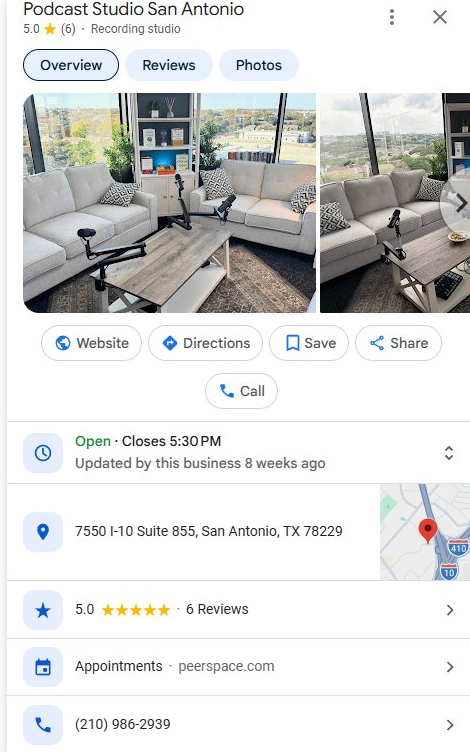
Here is why the profile mattered so much. The verified listing is what put Podcast Studio San Antonio in the local pack and on Google Maps for studio searches across the city. That local visibility — a real address, steady details, and real reviews — is exactly the kind of signal AI answer engines lean on when they decide which business to name. So the same listing that earned local-search traffic also made the brand citable: ask an AI for a San Antonio podcast studio and the studio shows up in the answer.
That is the chain, in order: the Google Business Profile drives local search, local search feeds the authority that AI tools cite, and those AI citations send ready-to-book traffic to the website — which turns into booked sessions and new clients. Take away the verified profile and the chain never starts. It did not happen by gaming the system; it happened by building a real presence across the places that matter: the map, the website, the directories, and the community. The map listing is the anchor. Everything else builds on it.
Case study: Hairway 2 Heaven 26, the best salon in Helotes
Podcast Studio San Antonio shows what a verified profile unlocks. Hairway 2 Heaven 26 shows what happens next, once you stop treating the profile as a checkbox and start optimizing it. It is the best hair salon in Helotes, Texas, and when the team committed to SEO, AEO, and Google Business Profile optimization, its search visibility did not creep — it climbed all year and then took off.

The profile work was not glamorous. It was thorough. The right primary category and real secondary ones. Real photos of the space, the team, and the work — refreshed, not stale. A complete description, accurate hours, and a booking link built right into the listing. Products and services filled out and pointed back to the website. Regular posts that keep the profile active and dated. On the page side, the site answers the exact questions a Helotes client types or asks an assistant, in plain language an AI can quote. Done together, that is what turns a verified listing into a listing that wins.
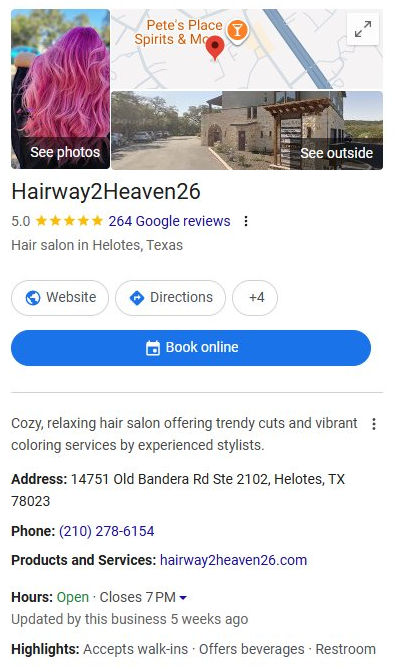
The part most businesses skip: making the ask
Look at that profile again. The single biggest reason it outranks other Helotes salons is not the photos or the categories. It is 264 reviews at a 5.0. Reviews are the heaviest local-ranking signal you control, and they are also what AI answer engines read when they decide who is “the best” salon in a town. You do not get to 264 by hoping. You get there by asking — and by making the ask feel like a natural part of the visit, not a chore bolted on afterward.
That is the lesson from Hairway 2 Heaven 26. The review has to ride along with the transaction itself. Here is what moved the number:
- Ask at the peak moment. The best time is the mirror moment — right when the client sees the finished cut or color and loves it. That feeling fades by the time a follow-up text lands two days later. Ask while it is still in the room.
- Make it one tap, not a scavenger hunt. A short review link or a QR code at the chair and the checkout that opens straight to the Google review box. Every extra step loses people. Fewer taps, more reviews.
- Build it into the handoff. The stylist asks in their own words while ringing up: “If you love it, a quick Google review really helps the shop.” Said in the moment, by the person who just did the work, it lands — a generic mass text does not.
- Reply to every review, by name. Responses show Google and AI tools that the listing is active and real, and they tell the next reader you actually care. A profile that answers is a profile that ranks.
- Keep it honest. Ask everyone, not just the clients you expect to rave. Never filter, gate, or buy reviews — that is against Google's rules and it puts the whole listing at risk. The goal is a real, steady stream, not a spike.
Tie those habits to every chair, every day, and the reviews compound the same way the rankings did. That is how a Helotes salon ends up at 5.0 across 264 reviews — and how it becomes the name that comes up when a neighbor, a search, or an AI assistant is asked for the best salon in town.
How to qualify the right way and protect your listing
If you work out of a coworking space, you do not need to gamble. You need to qualify cleanly and keep your proof ready.
- Get permanent signage. Ask your space about visible, lasting signage as a member — not a paper sign that comes down each night.
- Count the building directory. A permanent spot on the tenant directory, with your suite number, helps prove you are really there.
- Staff your stated hours. Be present and reachable during the hours you list. If you are not there, do not list those hours.
- Receive customers there. If customers never visit, you may be a service-area business instead. In that case, hide your address and set a service area.
- Match your name to your signage. Use your real business name. Do not stuff keywords into it — that is a fast way to get flagged.
- Use your own direct phone line. The number must ring to your business, not the front desk. A business cell phone is fine.
- Keep your records matching. Your name, address, and phone should match across your website, directories, and social pages.
- Be ready for the video. Keep your signage and space ready to record on short notice, so you pass on the first try.
A few things will get you flagged or suspended. Steer clear of these:
- Do not use a coworking space as a mailing address only.
- Do not invent suite or room numbers. Use the real one.
- Do not create more than one profile for the same desk or suite.
- Do not list a coworking address just to rank in a part of town where you have no staff.
Before you sign with any coworking space, ask whether you can grow into the space over time, whether the team understands and supports a verified Google listing, and whether they will let you post permanent signage as you scale. A good coworking partner helps you meet Google's bar, not skate under it.
Keep your verified profile strong after you pass
Verification is not the finish line. A coworking listing needs steady care to stay live.
- Post often, with dates. Regular Google posts build a dated record that you are open and staffed — useful if you ever need to appeal a suspension.
- Add real photos. Show your signage, your space, and your team, and update them when anything changes.
- Match your hours to the space. Your listed hours should not run past the hours the coworking space is open. A mismatch is a red flag.
- Use the Q&A feature. Post clear directions for finding your suite inside the building. It helps customers and shows the listing is real.
- Watch your category. If another tenant shares your exact category, Google may filter one of you out. Pick the category that fits you best.
- Add the “Located in” tag. Linking your profile to the coworking space it sits inside can help customers find you.
Google's rules are public and fairly clear. The hard part is the proof — and proof is exactly where most listings fail now.
A coworking address can be a smart, low-cost way to build a real-world presence. It only works if you treat it as a real place of business. The cost savings are real. So is the risk if you cut corners and get suspended. We connect your website, your map listing, your directories, and your content into one system that search engines and AI tools can trust. If you want help qualifying a listing or building that system, see how we approach SEO & AEO.
Frequently asked questions
Can I use a coworking space as my business address on Google?
Yes, but only if you meet all of Google's rules. You need permanent signage, your own staff on site during your posted hours, and customers who can actually visit. If you cannot meet all three, the address is not eligible.
What is the difference between a coworking space and a virtual office?
A virtual office is just a mailing address. You do not work there, so Google does not allow a profile. A coworking space is a real place you work, so it can qualify when you meet the signage, staffing, and customer-visit conditions.
What if I hot-desk and do not have a fixed desk?
Hot-desking is hard to verify, because with no fixed desk you may have no permanent signage. Ask whether the space offers signage at the entrance or on the tenant directory. If not, this address may not work for a listing.
Can a business that is “by appointment only” still get verified?
Yes, if you can show you are regularly staffed at the space. Google often suggests removing set hours and noting “by appointment only” in your description. Keep proof that you are really there.
Does my phone number have to be a landline at the coworking space?
No. It just has to be a direct line to your business. It cannot be the coworking space's main number or front desk. A business cell phone works fine.
Can a competitor get my listing suspended?
Yes. A competitor can file a report and trigger a review. That is why you keep proof ready — photos, dated posts, and signage. Strong, honest records make reinstatement far easier.
Can SEO and AEO really help a new brand beat established competitors?
Yes. Podcast Studio San Antonio did exactly that. A clear website, a verified map listing, directory listings, and community mentions can lift a new brand into a crowded space and into AI answers.
How do I get more Google reviews without breaking the rules?
Ask at the peak moment — right when the customer is happiest — and make it one tap with a short review link or a QR code. Build the ask into the handoff so it rides along with the transaction. Reply to every review, and never filter, gate, or buy them, which is against Google's rules. Hairway 2 Heaven 26 reached a 5.0 across 264 reviews this way.