One Recording. Every Platform. Every Way Your Buyers Look.
Your audience no longer picks one app or one format. They start an episode on one screen and finish it on another, then search Google or ask ChatGPT before they ever call you. Here's how Peachtree Rose Marketing turns a single podcast recording into YouTube, audio, Shorts, articles, transcripts and social posts that work together, and why that's now the only way a business podcast pays off.
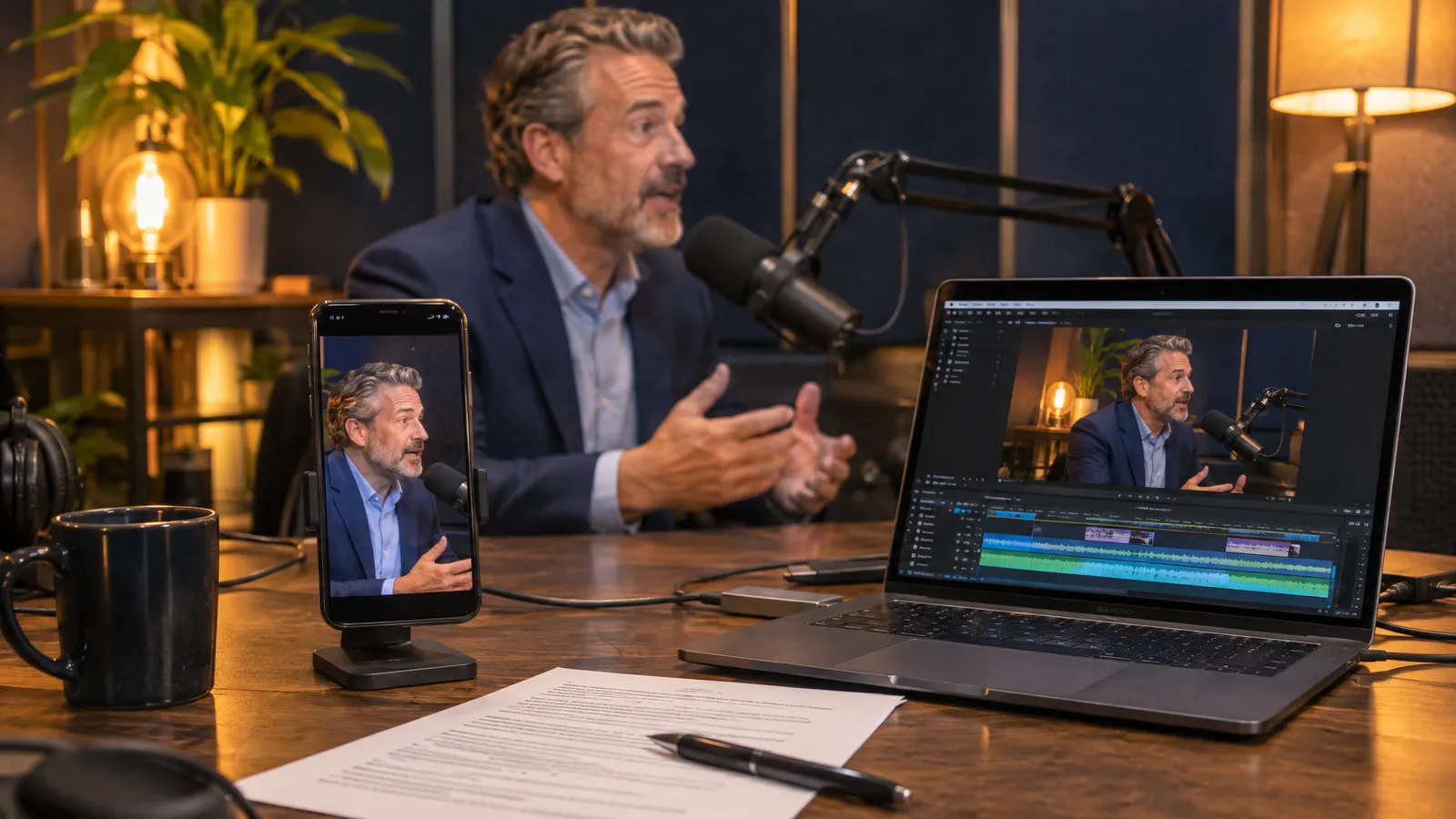
Most business owners who start a podcast make the same quiet mistake. They treat it like a show: record an episode, upload it, post a link and hope. But the people you want to reach don't consume a podcast the way they consumed radio. They watch a clip on Instagram, play the full episode in the car, finish it on a TV, search your name on Google and, more and more, ask an AI assistant who they should trust.
So the question isn't "Should we have a podcast?" It's "Is one recording reaching every place our buyers look?" Here's what the latest research says about how audiences move between formats, and the system we use at Peachtree Rose Marketing to make one session do the work of a month of marketing.
Audiences now switch formats and apps in the middle of an episode. In Acast's 2026 Podcast Pulse survey, 88% of podcast consumers use both audio and video, and 63% start an episode in one format and finish it in another. A business podcast that lives in one place misses most of its audience. The fix is a distribution system: the full video and audio episode, a transcript and article on your own website for search and AI answers, and short clips for every social platform, all from the same recording.
Your audience switches formats. Your content has to be waiting wherever they land.
Three studies released this fall point the same way:
- Acast's Podcast Pulse 2026, a survey of 4,300 people aged 16 to 64 across 13 markets, found that 88% consume both audio and video podcasts and 63% start an episode in one format and finish in the other. About three-quarters switch apps along the way.
- Audion and YouGov in France found that 58% of listeners start an episode on one platform and finish it on another.
- PodPoll 2026 in Australia found YouTube's share of podcast consumption climbed to 55%, yet 60% of people still say they prefer listening to watching.
Put those together and the "audio or video?" debate disappears. The same person might watch your first ten minutes on YouTube at their desk and finish in their earbuds on Loop 410. Edison Research's latest numbers, reported by TheWrap, rank YouTube as the number-one podcast platform among weekly U.S. listeners, ahead of Spotify (17%) and Apple Podcasts (9%). If your show only exists in one of those places, most of your potential audience never finds it.
Why the video version matters, even if your audience prefers to listen
Video does two jobs that audio can't. It shows people who you are, which builds trust faster than a voice alone, and it puts your show on YouTube, where people search for answers every day and where Google regularly pulls videos into its own results.
Advertisers have noticed. Magellan AI's Q3 2026 benchmark, covering more than 102,000 episodes and reported by Radio Ink, found that shows simulcast on YouTube kept their direct-response advertisers longer: 43% of those advertisers renewed for three months or more, compared with 34% on audio-only shows. Host-read ads made up 42% of placements on simulcast shows versus 32% elsewhere. You may never sell an ad, but the lesson carries over: when people can see you, they trust what you say more and they stay longer.
A podcast is not a channel. It's raw material for every channel.
The PRM Authority Flywheel: one session, every surface
This is how we turn one recording into a month of marketing for our clients. One studio session can produce 100 or more assets, and each one points back to the same home base: your website.
- 1Strategic discovery
Before we record, we map the questions your buyers type into Google and ask AI assistants, the objections your sales team hears, and the local searches you want to own. Every episode answers real questions.
- 2Record once, properly
A multicam session in our San Antonio studio or on-site at your office or event: each speaker on their own 4K camera with broadcast audio, so every later format starts from clean material.
- 3The full episode, everywhere
The edited video goes to YouTube with chapters, a keyword-led title and description. The audio goes to Apple Podcasts, Spotify and every other app through one RSS feed you own.
- 4Transcript and article on your website
A human-reviewed transcript and a written article built from the episode publish on your own domain, with FAQ and podcast schema markup. This is the asset Google ranks and AI answer engines quote.
- 5Short-form clips for every platform
Vertical clips cut from each speaker's own camera, captioned and sized for YouTube Shorts, Instagram Reels, TikTok and LinkedIn, each linking back to the full episode or the article.
- 6Quotes, carousels and posts
Pull quotes, LinkedIn carousels, Google Business Profile updates and newsletter sections turn the best two minutes into a week of posts for your team and your guests to share.
- 7Measure and feed it back
Tagged links and form tracking show which episodes and clips bring in leads, and that shapes the next recording. (We explain the scorecard in our guide to podcast metrics that matter.)
Post the episode
- Audio on one app, or video on YouTube only
- No transcript, so search engines and AI see nothing
- A link posted once on social media
- Downloads as the only measure of success
Distribute the episode
- Video and audio, on every major platform
- Transcript and article on your site for SEO and AEO
- Ten or more clips scheduled across platforms
- Leads and AI citations tracked back to each episode
Transcripts: the bridge between your podcast and AI search
Search engines and AI answer engines can't listen to a 40-minute conversation. They read. A transcript turns everything you said into text that Google can index and that ChatGPT, Perplexity and Google's AI Overviews can quote, with your name attached.
Accuracy is becoming a standard, not a nice-to-have. In November 2026, SiriusXM and Pandora filed a proposed consent decree with the National Association of the Deaf to resolve a 2021 accessibility lawsuit over podcast transcripts. Under the proposal, which still needs court approval, transcripts must say whether they were produced by AI alone or reviewed by a person, identify speakers and describe meaningful sounds, and 30 shows chosen from the company's top 50 get human editing. The decree runs for 36 months after approval.
For a business podcast, the takeaway is practical:
- Have a person review every transcript. AI transcription misspells names, products and local places, and those are exactly the words you want to be found for.
- Label speakers and add chapters. Clear structure helps readers skim and helps machines understand who said what.
- Publish it on your own domain, not just inside a podcast app, with FAQ and episode schema so it can be cited. See how SEO and AEO work together, and check whether AI can find your site with our AI citable checklist.
What this looks like for a San Antonio business
Here's an illustrative month for a professional services firm, say a CPA practice that records once a month:
- One half-day session produces three or four 25-minute conversations: two with partners on year-end tax questions, one with a client who sold a business, one with a local banker.
- Four full episodes go to YouTube and the podcast apps, one a week.
- Four articles on the firm's website target searches like "small business tax planning San Antonio," each with the episode embedded and a reviewed transcript.
- Thirty to forty clips run across Shorts, Reels, TikTok and LinkedIn, with the partners and guests sharing their own.
- Google Business Profile posts, a newsletter section and LinkedIn carousels come from the strongest quotes.
Same recording. Dozens of chances to be found, all pointing back to one website built to convert. That compounding is what we mean by content authority.
How to start without adding staff
- Start with questions, not topics. List the 20 questions prospects ask before they buy. That's your first season.
- Record in batches. One focused session a month is far easier to keep up than a weekly scramble, and consistency is what lets a show build an audience.
- Make your website the hub. Every clip and post should send people to a page you own, not just to a podcast app. If your site isn't ready for that, start with a website built for leads.
- Plan clips before you record. Ask guests for a strong opinion, a specific number and a short story, and you'll have your best clips before the edit starts.
- Hand off the production. Our done-for-you podcast production covers recording, editing, clips, articles and distribution, so your only job is the conversation.
Frequently asked questions
Should a business podcast be audio or video?
Both. Acast’s 2026 Podcast Pulse survey found 88% of podcast consumers use both audio and video and 63% start an episode in one format and finish in the other. Record on camera, publish the video on YouTube and the audio to podcast apps through one RSS feed.
How many pieces of content can one podcast recording produce?
A single well-planned session can produce full video and audio episodes, an article and transcript per episode, 10 or more short vertical clips per episode, quote graphics, LinkedIn carousels, Google Business Profile posts and newsletter sections. At Peachtree Rose Marketing, one studio session can yield 100 or more assets.
Why do podcast transcripts matter for SEO and AI search?
Search engines and AI answer engines read text. A human-reviewed transcript published on your own website turns what you said into indexable, quotable content, so Google can rank it and tools like ChatGPT, Perplexity and Google AI Overviews can cite you.
Is YouTube the biggest podcast platform?
In the U.S., yes. Edison Research data reported by TheWrap in November 2026 ranks YouTube as the number-one podcast platform among weekly listeners, ahead of Spotify at 17% and Apple Podcasts at 9%.
Do I need my own podcast studio?
No. You can record in a professional studio by the session, such as Podcast Studio San Antonio, or have a crew come to your office or event. What matters is clean multicam video and audio, because every later format is cut from that recording.
What is the PRM Authority Flywheel?
It is Peachtree Rose Marketing’s process for turning expertise into visibility: strategic discovery of the questions buyers ask, one recorded session, distribution of the full episode and clips across platforms, articles and transcripts on your website for SEO and AEO, and measurement that shapes the next recording.
Sources
- Acast: Podcast Pulse 2026 (Sep 17, 2026)
- Podnews: Audion and YouGov research on French podcast listening (Nov 3, 2026)
- PodPoll 2026 press release, Australia (Nov 4, 2026)
- TheWrap: Apple video podcasts, YouTube and Spotify, citing Edison Research (Nov 16, 2026)
- Radio Ink: Podcasts simulcast on YouTube get more repeat ad buyers in Q3 (Nov 10, 2026)
- Magellan AI: Podcast Advertising Benchmarks Q3 2026
- Podnews press release: SiriusXM and Pandora transcript consent decree (Nov 18, 2026)